
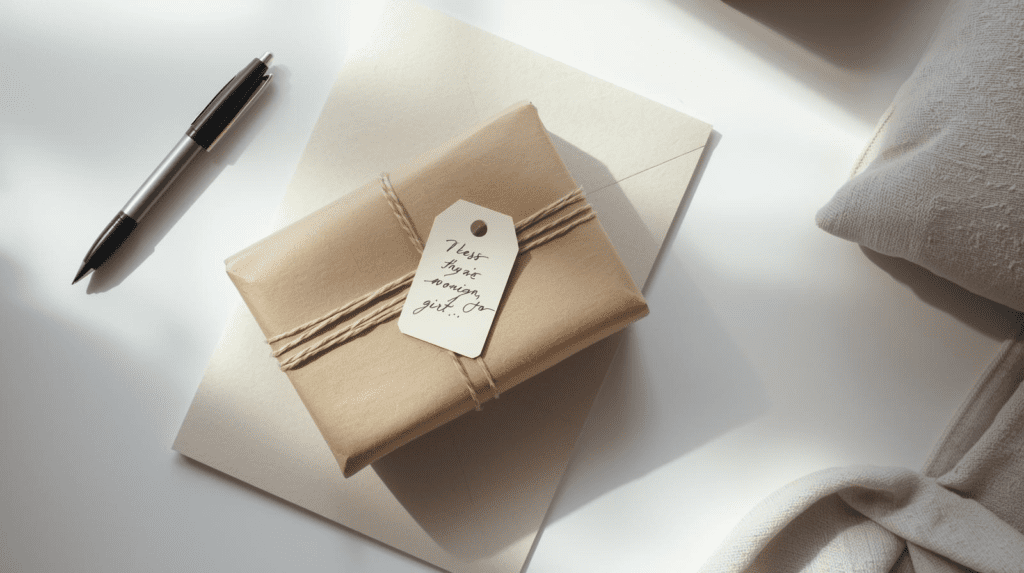
Personalising a gift doesn’t require crafting skills, special tools, or hours of effort. In fact, the most effective DIY touches are often the smallest ones — subtle details that show attention without drawing focus to the process itself.
Many people avoid “DIY gifts” because they associate them with pressure, mess, or things that feel unfinished. But thoughtful personalisation isn’t about making the gift from scratch. It’s about adding context. A small, intentional touch can transform a perfectly ordinary gift into something that feels chosen rather than bought.
This guide focuses on low-effort, high-impact ways to personalise gifts — approaches that work even when time is short and confidence is low.
Why Personal Touches Matter More Than Handmade Gifts
Handmade gifts often carry expectations — gratitude, display, emotional response. Personal touches don’t. They sit alongside the gift rather than competing with it.
A personalised detail tells the recipient that the gift wasn’t generic, even if the item itself is widely available. That distinction matters. It shifts the focus from effort to intention, which is usually what people respond to most.
A Short Note That Explains the Why, Not the What
One of the simplest DIY touches is also one of the most effective: a brief note that explains why the gift made sense for the recipient.
This doesn’t mean justifying the choice. It means offering context. A single sentence tucked into a card or tag can anchor the gift to a habit, interest, or moment — instantly making it feel personal without being emotional.
Thoughtful Wrapping That Signals Care Without Fuss
Wrapping doesn’t need to be elaborate to feel intentional. Simple materials — neutral paper, fabric wrap, or understated ribbon — often feel more thoughtful than busy or themed designs.
What matters is consistency. When the wrapping aligns with the tone of the gift, it reinforces calm and care rather than spectacle. This is especially effective for adult gifting, where restraint often reads as confidence.
Adding One Small, Meaningful Extra
A small addition can personalise a gift without overwhelming it. This might be something that complements the main item — a bookmark inside a book, a handwritten recipe card with a kitchen gift, or a note suggesting how you imagined it being used.
The key is relevance. The extra should feel supportive, not decorative. When it makes sense alongside the gift, it enhances rather than distracts.
Using Familiarity Instead of Customisation
Personalisation doesn’t have to mean names, dates, or engraving. In many cases, familiarity is more powerful.
Choosing a colour someone always gravitates toward, a format they prefer, or a version of something they already use well shows attentiveness without permanence. This kind of personalisation feels natural rather than performative.
When DIY Works Best for Last-Minute Gifting
Personal touches are especially useful when time is limited. A small handwritten note, a thoughtful presentation choice, or a relevant pairing can quickly elevate a last-minute gift.
This approach works well alongside ideas from Best Last-Minute Gifts That Still Feel Thoughtful, where the goal is calm relevance rather than speed. When the gift fits into real life and the personal touch explains why, urgency becomes invisible.
What to Avoid When Adding Personal Touches
Overdoing DIY is a common mistake. Too many elements, explanations, or layers can make a gift feel heavy or self-conscious.
It’s also best to avoid personalisation that locks the recipient into a specific memory or emotion unless you’re certain it will be welcomed. Subtlety is usually safer — and more effective.
How to Choose the Right Personal Touch
The most useful question to ask is simple: What would make this gift feel more “them”?
Often, the answer isn’t a craft project, but a sentence, a material choice, or a small supporting detail.
This mindset aligns closely with The Art of Thoughtful Gifting: Why It Matters, where intention consistently outweighs effort. You may also find Wrapping and Presentation Ideas That Make Any Gift Feel Special helpful when refining how a gift is received, not just what it is.
Research highlighted by the American Psychological Association also suggests that perceived intention plays a significant role in how gifts are emotionally received — reinforcing why simple, sincere personalisation tends to land best.
Final Thoughts
DIY gifting doesn’t have to mean doing more. Often, it means noticing more.
When a gift includes one quiet, personal detail, it signals care without demanding attention. The result feels thoughtful, not handmade — and that’s often exactly what people appreciate most.